
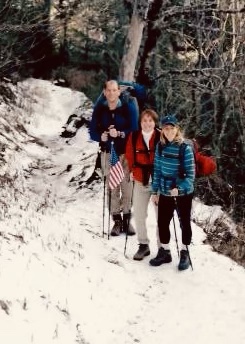
We lingered too long along the clifftop overlooks. We had not seen each other in months, so our trail lunch turned into a reunion filled with stories of our new babies. It was a cold November day in the Smokies, and Tom had packed a small camp stove. We ended lunch with decadent hot chocolate and cowboy cookies from the Amish Bakery, when we suddenly realized we would not make it to LeConte Lodge before dark. Once the sun was gone, the here-and-there snow and ice made our path feel so much more treacherous. Easy steps over snowy patches or slick rocks now felt like potential broken hips and helicopter evacuations. Thank the Lord, we all had headlamps for the journey.
Now a flashlight or headlamp does not make decisions for you. The light does not tell you just where to place your next step or guarantee that you will not slip off the cliff. A good light partners with you, helping you decide where to next step, letting you see the ice or the sharp turn in the trail. We moved slowly and thoughtfully, but thanks be to God and our headlamps, we made it into camp in time for supper.

The Psalmist seems stuck on a metaphorical mountain on a moonless midnight. They cry out to God, “Your word is a lamp before my feet and a light for my journey.” Now just what the Psalmist means by ‘your word’ or ‘your commandments’ is not entirely clear, as the Bible was still being written when the poet penned those lines. Many Christians, maybe most, call the Bible the Word of God. We Methodists have a more nuanced understanding of the Word of God. In Article IV of our EUB Confession of Faith we declare about the Holy Bible: “We believe the Holy Bible, Old and New Testaments, reveals the Word of God so far as it is necessary for our salvation. It is to be received through the Holy Spirit as the true rule and guide for faith and practice.” We believe the Word of God is bigger than the Bible. We believe the Creator, risen Christ, and Holy Spirit still show up and help reveal the Word of God to us.
Connie and I experienced a painful couple of years as we navigated infertility and loss together. Our issues were and are ours alone. I sometimes joke that we have been married for 35 years, 33 good ones. Most of us would sign on for that. These were surely the hardest few years of our 35 years of marriage, and in December of 1997, we found ourselves on the high-risk floor of Centennial Medical Center for Women with an IV drip holding off Connie’s contractions. Connie was extremely uncomfortable and said little, communicating mostly with gestures: lip balm- ice chips. We still argue whether any of her hand gestures were rude. Connie wanted no conversation, music, or TV noise. I sat in a rocker reading. I found myself reading over and over again the story of Zechariah and Elizabeth from Luke 1. I have no idea why it brought such comfort, or how it became for me the present Word of God in those terrible moments. I would like to tell you the birth of John gave me hope, but I am pretty sure that was not the case. No, I think the story shone a more subtle glow on my path. I found comfort in Zechariah’s willingness to question God’s top angel, “How can I be sure of this? My wife and I have had our hearts broken like 7 times.” Now that the angel smugly pulls rank, name-drops God and smites Zechariah did not even trouble me theologically. “I am Gabriel, I stand in God’s presence.” (Grow up Mr. Angel; try some humility; Jesus will be born in manger; get over heavenly yourself.) “I was sent to speak to you and to bring this good news to you. Know this…because you didn’t believe, you will remain silent, unable to speak until the day when these things happen.” As I sat in the hospital room in silence, the story of doubt offered such abiding comfort, not with answers but with the presence of God.
The Bible is about people experiencing God. Through the doubts, fears, joys, missteps, mistakes, sins, experiences, Good Fridays and Easters the Bible shines holy light into hospital rooms, lonely cemeteries, and the outer walls of middle school dances. The Bible rarely shows us exactly what to do next. There is no section on cell phone boundaries for teenagers or end of life medical decisions- there were no cell phones or ventilators. And yet somehow when we have learned to read Scripture symbolically and an openness to the Spirit the Bible shines the light we need, telling us about the relentless love of God that never gives up on us.
Yes, the Bible has some rules, some behavior maps, some boundaries like love God, love your neighbor, do unto others as you would have them do to you, treat immigrants like native born, practice mercy, do not store up wealth on earth… but mostly the Bible reflects God’s presence to us in the people we encounter like a Zechariah doubting an angel. Think about Jesus our Christ (not his teaching) for a minute, but Jesus- God incarnate: born in a stable, refugee to Egypt, bringing healing, talking to every kind of person, laying aside carpentry to teach and live without a permanent home, dining with so-called sinners, touching those excluded as unclean, tired, weeping, praying all night, flipping over tables, washing feet, forgiving, restoring, challenging, transforming, crucified, dead, buried, raised, and going ahead us appearing to Magdalene, Mary, Peter, Paul, John Wesley, and even you and me. These parables, portraits, icons show us what God’s Love looks like in human form.
Psalm 119 is an alphabetic acrostic, with the end of each section ends and the next begins with the same letter of the Hebrew alphabet; a 176 acrostic is just kind of bad art right off. And if we read all 176 lines of Psalm 119, we will encounter a lot of self-righteous, self-congratulatory, pompous horn honking. “I keep your word close, in my heart, I declare out loud all the rules you have spoken. I rejoice in the content of your laws over great wealth. I hate fickle people. I delight in your statutes; I will not forget what you have said. Your laws are my joy—I’ve chosen the way of faithfulness; I’m set on your rules. I’m holding tight to your laws, your commandment makes me wiser than my enemies!” Yuck! If you did not feel icky, perhaps you have never met those kind self-righteous, super-sure people of all strips. However, below that smug self-congratulatory veneer is someone barely holding on.
“My whole being yearns for your saving help. I wait for your promise. My eyes are worn out looking for your Word. When will you comfort me? I ask because I’ve become like a bottle dried up by smoke.” In the final verse the Psalmist gets real and acknowledges their brokenness, “I’ve wandered off like a sheep, lost. Find your servant…”
The Psalm ends, “I’ve wandered off like a sheep lost on the rocky mountain side on a moonless midnight; oh, I am like an empty bottle… find me, fill me, save me, Come be my light, shine on my path.”
Oh, friends, the Word of God is not a passive ancient map or restrictive rulebook. The Bible helps reveal God’s Word right now – right here- with us. It is a lamp unto our feet and a light into our paths leading us through all manner of dark valleys and silent hospital rooms toward green pastures and still waters, restoring our souls. Come let us encounter the Word of God in the Scriptures, for the Word of God “is living and active” and among us! (Hebrews 4) Amen.
 pastorpaulpurdue