
If you had the hubris to write a book filled with everything people need to know about God, how might you organize it? Would you open such a Bible with a chapter of definitions and terms? Would you organize your chapters with titles like “how worship feeds our souls” or “dealing with oppression, evil and injustice”? If you wanted to convey how deeply God cares about injustice, would you list principles or tell the story of a fugitive prince turned shepherd, who after a life-changing conversation with a burning bush returns home to liberate the nation he once fled? Could you make clear God’s boundless love with a list of rules or would you tell a story about a twenty something who demands their inheritance, leaves home, burns through the money, ends up on the streets begging, comes to themselves, travels home rehearsing an apology, only to be embraced with wide open arms, restored to a place at the table, and given a lavish homecoming party?
Isn’t the Bible mostly a story of people and our experiences with God? Abraham and Sara, Isaac and Rebecca, Jacob and Esau, Joseph and his brothers, Moses and Miriam, Samson and Deliahla, David and Jonathon, Elijah and Jezebel. And given that it is a human story, the Bible is full of our missteps, misadventures, and even misunderstandings of what God is doing. There are teachings, commandments, poems, and history but the Bible tells a story of our human experiences with God. What does this human lens tell us about God, our relationship with God, and how we best experience God?
In the New Testament, the four Gospels tell us Jesus’ story but again the books are named after people: Matthew, Mark Luke & John. Next, we hear of the Acts of the Apostles and then letters Paul or a Pauline disciple wrote letters to congregations: Galatians, Ephesians, Philippians, and Colossians: and in those letters, we only get half of the conversation! Given the Bible’s human lens, how deeply does Almighty God entrust humanity with the divine story?
As Christians, we believe that when God wanted to send the clearest revelation of God’s very self, God sent God’s very self to embody our human form- born in a manger, refugee to Egypt, arrested for preaching about a different kind of kingdom. How deeply does God love our human family to become one of us? As to messaging, God, come as Christ, calls disciples into community and seeks to build the blessed community we call the kin-dom of God. (Matt 4)
If God tells God’s story by becoming one of us, and speaks through the failures of the disciples and missteps of congregations like the Galatians (“who bewitched you?”) then can we really do faith apart from a community of faith? (Gal. 3) Perhaps, Christianity is not so much a series of rules or theological beliefs but a deep relationship with God, ourselves and one another. “Love God- Love neighbor as self” (Matt.22) is a kind of trinitarian relationship: 1) God loves you, 2) love God with your all, 3) love neighbor as self. I am beginning to wonder if we can experience the Risen Christ apart from Christian community? Wesley believed we could not! Not that God’s Spirit does not reach out to all people, or that we can’t survive in spiritual isolation, but God made us for the vulnerability of community and God promises to appear amongst us when we are in community. Maybe 2 minutes after making Adam from the mud, God said “it is not good for humans to be alone” (Genesis 2) And Jesus said “Again I assure you that …where two or three are gathered in my name, I’m there with them.” (Matt.18) We find the presence of God in the presence of each other. God’s call to dwell in a spiritual community (family) deeply challenges our individualistic, isolationist, and consumerist lifeways.
Today is Baptism of the Lord Sunday, a day when we remember and renew the vows we have made inside our community of faith. Listen for the call to be in a relationship with each other?
- On behalf of the whole Church, Do you renounce the spiritual forces of wickedness, reject the evil powers of this world, and repent of your sin?
- Do you accept the freedom and power God gives you to resist evil, injustice, and oppression in whatever forms they present themselves?
- Do you confess Jesus Christ as your Savior, put your whole trust in Christ’s grace, and promise to serve Christ as your Lord, in union with the Church which Christ has opened to people of all ages, nations, and races?
- Do you believe in God: our creator? Do you believe in Jesus Christ? Do you believe in the Holy Spirit? Even here we see God in a trinity- or relationally.
- Will you nurture one another in the Christian faith and life and include one another in your care? Will you do all in your power to increase each other’s faith, confirm their hope, and perfect them in Love?
- Will you uphold this congregation with your prayers, your presence, your gifts, your service and your witness?
And then we pledge: With God’s help we will proclaim the good news and live according to the example of Christ. We will surround one another with a community of love and forgiveness, so that we may grow in service to others. We will pray for each other, so that each of us might live as a true disciple walking in the way that leads to life. Amen!
Paul writes in 1 Corinthians 12 “We were all baptized by one Spirit into one body, whether Jew or Greek, or slave or free, and we all were given one Spirit to drink. We are one body, don’t say to anyone “I don’t need you”!
We need each other. Our baptismal vows connect us in Christian community. And we will need to practice patience, kindness, forgiveness, gentleness, self-control and generosity because our faith communities are made up of people like us capable of missteps, mistakes, and misunderstandings.
In Romans 12 Paul lists a long list of admirable behaviors, but amid all the doing of faith, Paul posits one deeply radical idea: “we are one body in Christ, and individually we belong to each other.” We belong to each other. We become the body of Christ together. Christ is our peace, breaking down the barriers, issues and racism/tribalism/homophobia that separate us (Eph 2). “We belong to each other” is a deeply radical notion. We can’t be Christ’s body alone- no matter how talented or righteous we are. Why does Christ best arrive inside community- perhaps because we can’t love in isolation?
Over the next several weeks, we will begin exploring what our clergy staff is calling “A Habitat of Grace”. A habitat is everything we need to grow and thrive- we all need God’s grace. We best experience grace together. We need each other to be the body of Christ. This Habitat of Grace framework flows from our baptismal vows. There are Seven habits or elements that we need to grow and thrive spiritually.
- Being in Community: This is the vow of presence
- Praying
- Reading Scripture
- Worshiping:
- Giving:
- Serving
- Sharing God’s Love or bearing of love and for justice Witness
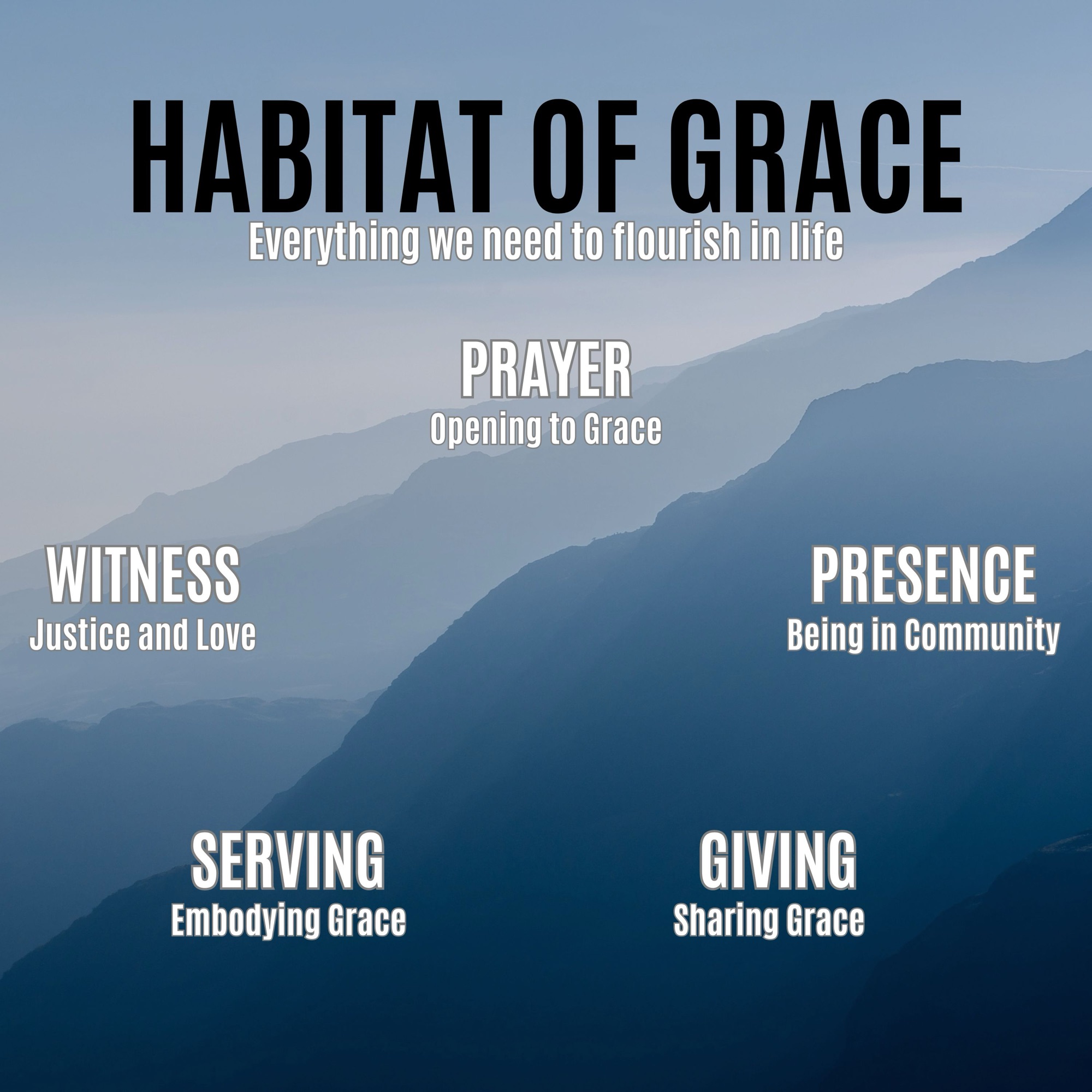
We learn these habits best inside community. We will be talking about these foundational traits on Wednesday nights at 6 and introducing some new small group communities during Lent in early February.
Oh friends, God told God’s story through people, people like you and me, people capable of mistakes and masterpieces, we need each other. We can’t do Christianity in isolation. As we begin this new year by renewing our baptismal vows together let us remember “we are one body, we belong to each other”. We find God’s presence best in the presence of community- let us resolve to be more present inside of our faith community, so that God’s grace might be more present with us. Amen
 pastorpaulpurdue