
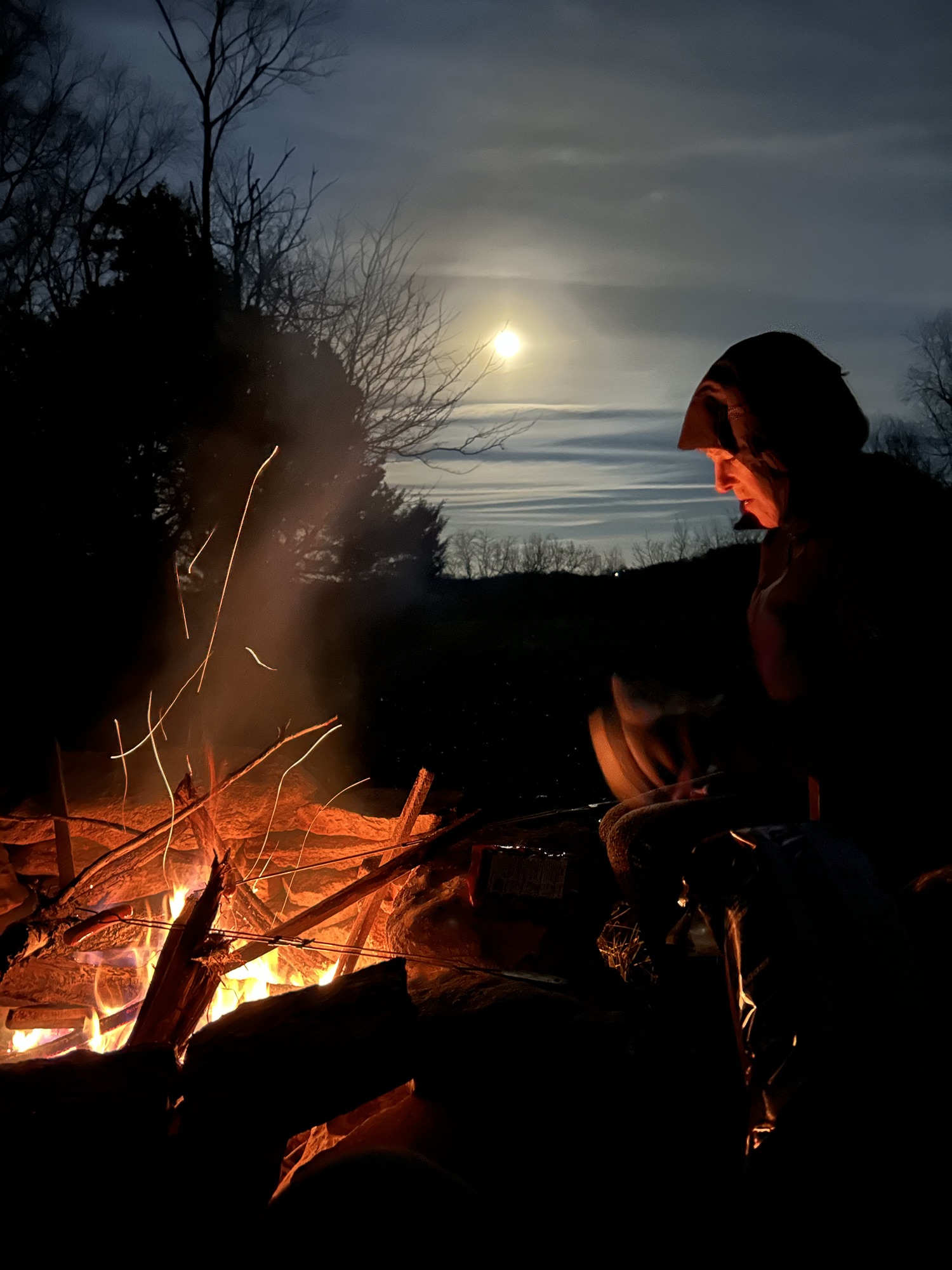
I’ve always loved watching a campfire, how the flames dance up into the night sky. In the Biblical age, fire provided any light at night, made possible every cooked meal, kept people warm, and forged pottery or metal. As a child hearing the Pentecost story, I got lost in the wonder of the tongues of fire: “Divided tongues, as of fire, appeared among them, and a tongue rested on each of them.”
We Methodists celebrate these tongues of spiritual fire in our Cross and Flame symbol. Flames are a metaphor or sign of God’s presence that perhaps began as Abraham built that first altar?
We see fire’s mysterious beauty as Moses, caring for his sheep, turned aside to investigate a strange sight. Up on the mountain there was a bush burning, but somehow as the flames danced around the tree the leaves, bud’s and bark did not burn up. As Moses drew near God spoke “Go down Moses, way down in Pharaoh’s Land, tell old Pharaoh let my people go.” (Exodus 3)
After the people broke Pharaoh’s chains and passed through the Red Sea, Moses went up on Mount Sinai and came down with the Ten Commandments. Exodus 20 tells us “Now all of Mount Sinai was wrapped in smoke, because the Lord had descended upon it in fire and the smoke went up like from a kiln. The whole mountain shook violently and Moses spoke to God and God answered Moses in the thunder.” Tongues of fire gave us the Law, guiding us with some boundaries for our living.
In the last scene in the Exodus the people built the Tabernacle. They placed the altar, the ark, the bread of presence, and the lampstand in it and prayed and “Then the cloud covered the tent of meeting, and the glory of the Lord filled the tabernacle… for the cloud of the Lord was on the tabernacle by day, and fire was in the cloud by night.” Tongues of fire to guide the journey.
The Psalmist wrote: “Your word is a lamp to my feet and a light to my path.”
Jesus proclaims “You are the light of the World.” ( Matt 5)
Persecuted for speaking out against his own nation, the High Priest put Jeremiah in stocks outside the Temple. Picture that. No doubt discouraged and downcast Jeremiah vents the struggle through poetry. “I speak, I must cry out; I must shout, “End this Violence!” For the word of the Lord has become a reproach and derision for me. If I say, “I will not speak out” then within me there is something like a burning fire shut up in my bones; I am weary with holding it in, and I cannot.” (Jer. 20) The prophetic words sometimes burn in our ears and linger in our bones, stinging us onto the paths of justice, liberation and love.
“They were all together in one place. Suddenly a sound from heaven like the howling wind filled the room and they saw something like flames of fire alighting on each one of them and they were all filled with the Holy Spirit.” As I grow older I focus more on the radical Pentecost message: “They were all filled with the Holy Spirit” and they all found their voice in the Spirit.
God does not need to be appeased by our burnt offerings. God is not just up on life’s mountain tops, found inside our temples, or locked inside the Commandments: God is with us, dancing around us, over us, around us, within us, showing us the way, teaching us to sing and lifting up every voice.
“They were all filled with the Holy Spirit.” They were all filled with the Spirit, Parthians, and Persians, straight and gay, men and women, Jews and Arabs, young and old, dreamers and planners, observant and lax. “They were all filled with the Holy Spirit!” Pentecost declares that the Spirit empowered people from every nation under heaven to speak the word of God using their own culture, language and idioms. “Parthians, Medes, and Elamites; residents of Mesopotamia, Judea, and Cappadocia, Pontus, and Asia, Phrygia and Pamphylia, Egypt, Libya, Cyrene; Romans, Greeks and Arabs—we hear them in our own languages!” How might this passage challenge us and help us get along? Is not God working with people who speak, worship and understand things differently than we do?
What does this Pentecostal mystery of language, translation and empowerment mean? Peter preaches an answer in Greek, but quotes Joel who wrote in Hebrew, and we read the verses in English, Thai or Karen. We might worry more about things getting lost in this triple translation (Hebrew to Greek, Greek to English) except we hear the message that God’s Spirit is with us! God’s very spirit dances with us, God’s Spirit comes as a lamp unto our feet and a light unto our Path.
God has said, I will pour out my Spirit on all people.
Your sons and daughters will prophesy.
Your young will see visions. Your elders will dream dreams.
even upon my people who are enslaved, I will pour out my Spirit, they will prophesy!
Matthew’s Gospel ends with Jesus offering the benediction, “Go I am sending you out to make disciples, and never forget, I am with you to the very end, do not be afraid.” John Wesley loved to quote Romans 8:16 “That God’s Spirit testifies with our (human) spirit that we are children of God.” God’s Spirit can somehow strangely warm our hearts, telling us we are the beloved children of God. God is not just up on the mountain top, found in our temples, or holed up in the Commandments- God is right here with us, in us, on us, all around us, lifting up every voice, and showing us the way. Tongues of Spirit fire dance around us. Christ is with us. Let that love be a fire in your bones. And may the truth that “They were all filled with the Holy Spirit” slow us down a bit, so we might even learn to hear from our enemies. Amen.
 pastorpaulpurdue