
What has nourished you? What has carried you to this place where you now stand? If I was to think of a symbol of what fed me as a child, I could place a mason jar of homegrown green beans on the altar. Every summer, we picked bushel baskets of beans at the family farm, we strung, snapped and mom canned hundreds of jars of “half runner” green beans. Those green beans along with some canned tomatoes, crab apple jelly and strawberry preserves filled a 12 foot long, 3 feet wide, and six foot high shelving unit that Dad built in our basement. We had Green beans at every meal except breakfast and mom thought that serving “store bought” beans was nearly sinful.
Our passage tells how the Hebrew people put a jar of manna inside the Ark of the Covenant inside the Tabernacle. The Ark featured angel wings shielding an empty chair reminding the people that God could not be reduced to an idol. Inside the Ark they placed the Ten Commandments, Arron’s flowering almond bud staff and a jar of Manna. Imagine a jar of food as a liturgical object. The word Manna can be translated as “what is it?”. “What-is- it” is not a bad name for the miracles that feed our souls and sustain us when we find ourselves in some sort of wilderness. What has fed you? What little miracles have carried you through wilderness seasons? What experiences, people and events adorn the altar of your heart? What thanksgiving will you offer at the communion rail this morning?
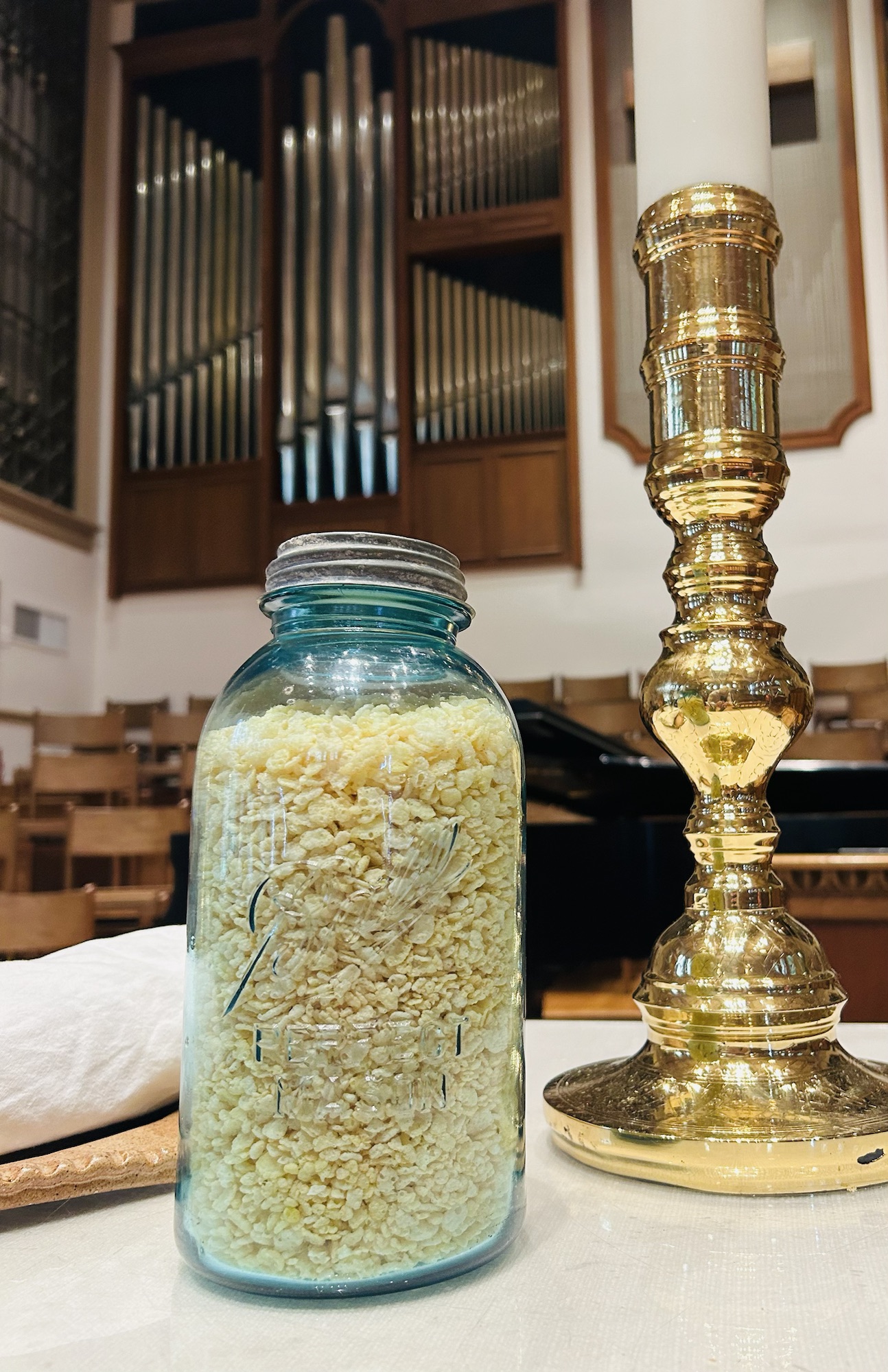
The stories in Exodus are not breaking news stories, or eyewitness accounts posted on Twitter. Exodus reads like a novel looking back on long past events from the comfort of the Promised Land. The end of Chapter 16 illustrates a sense of distance or gained perspective after a 40 year journey. “The Israelite people called it manna.” The writer then describes manna’s forgotten taste, color, and texture: “It was like coriander seed, white, and tasted like honey wafers.” Like museum narration it adds, “Let an omer of it be kept safe for future generations so that they can see the food that God used to feed us in the desert when God brought us out of Egyptian slavery.’” It even notes how much an omer is, as the audience has long forgotten the omer system. Events feel different from the comfort of Promised lands, but wisdom reminds us to not forget the manna that makes us who we are. What has fed and led you into a better place?
Exodus notes that “the Israelites ate manna for forty years, until they came to a livable land.” When have you felt stuck in an unlivable land? I know during this beautiful Pride month some of you have moved through a wilderness of exclusion and hate. Even while still journeying, perhaps we might pause and remember who, when and what has brought us this far? On June 19, or Juneteenth will our nation pause and ponder a day of victory in our unfinished battle against our nation’s original sin of racism. Who are the martyrs, poets, dreamers, moms, dads, visionaries, and lunch counter leaders who helped us move to a better place? Will we sing of hope even as we name the stony road we trod, the weary years, and the silent tears? Can we aspire to sing with James Weldon Johnson?
Lift every voice and sing,
Till earth and heaven ring,
Ring with the harmonies of Liberty;
Let our rejoicing rise
High as the list’ning skies,
Let it resound loud as the rolling sea.
Sing a song full of the faith that the dark past has taught us,
Sing a song full of the hope that the present has brought us;
Facing the rising sun of our new day begun,
Let us march on till victory is won.
(“Lift Every Voice and Sing”)
If we forget the bitter roads we might not realize how far we have come, who has borne the weight of the struggle, and how far we still have to go. Our jars of Manna from Heaven are mile markers helping us find our personal and collective way. What has fed your soul?
It had been 3 months since they left slavery, abuse, forced labor, and being treated as unwelcome immigrants in a nation they helped build. Three months into freedom, “the whole Israelite community complained against Moses and Aaron in the desert saying “Oh, how we wish that the Lord had just put us to death while we were still in the land of Egypt. There we could sit by the pots cooking meat and eat our fill of bread. Instead, you’ve brought us out into this desert starve to death.” They remembered living in the breadbasket of the ancient world, where the Nile river’s regular flooding made for amazing soil and offered seemingly endless irrigation opportunities. Their enslavers made sure they had enough to eat, not enough to escape, but enough to not rise up. The people forgot how they called out to God about evil, injustice and oppression. They forget their past within the first quarter of freedom.
We often forget how hard and long systemic change takes. Three months before they were day laborers building pyramids without straw and tenant farmers working Pharoah’s wheat fields, and now they are free people living in the desert mountain wilderness, picking fruit from cactuses and eating grasshoppers. No wonder some people wanted to go back to less complicated days.
Jesus cautions us about the change curve, but the church and the larger culture usually forgets that changing for the better is hard disruptive work. Jesus says in 3 Gospels “Nobody pours new wine into old wineskins. If they do, the fermentation bursts the wineskins and both bottle and wine will be lost.” Doing new things requires new systems. Jesus adds “No one who drinks a well-aged wine wants new wine, but says, ‘The well-aged wine is better.” Churches are sometimes the worst at taking traditions and turning them into idols, we do that with beloved leaders, styles of music, rituals, pews, and theology. (Luke 5) One of my churches seemingly enshrined the forty year old carpet as sacred!
So what does Moses do with the people’s complaints? Moses might have just quit or scolded the people reminding them of their prayers for deliverance, but instead of a lecture Moses and God fed the people. They pray and manna falls from the Heavens. The people said “what is this?”
Some say the manna was seeds foraged from wild plants, or resin from tree bark, or a kind of honey like gum made by grasshoppers that evaporated with the morning dew, and a few less scholarly souls have speculated that Wonder Bread fell from heaven. I love that the people called these white frosted flakes, “what is it?” Sometimes we do know what exactly sustains us. Sometimes we don’t know exactly how we found God’s gracious path. Often we forget to pause in prayer and notice the little miracles that keep us going. What is the who-what-where-&-when that brought us this far? What faces, photos, poems, experiences, events and songs might you place in a jar on your altar? Who traveled the stony road before you? What has helped you stand in this place of pride today? What has fed you?
On Monday, Connie and I celebrated 36 years of marriage. On these little personal holy days we often reflect on the “what is it” that helped make us who we are together. Somehow, we ended up talking about how 35 years ago Connie invited me to a barbeque with her work friends. Connie knew we would be the only straight people there, I did not. It would be 25 years before the Supreme Court cleared the way for gay marriages in Tennessee. It was 1989, I was 22 and I was the only male at a lesbian led cookout- and the only Southern Baptist youth minister. As we enjoyed our 36th anniversary dinner, I asked Connie what led her to leave behind her childhood theologies about gay people and trick me into going to that cookout at Kelly’s house? Connie immediately answered “Lowell.” Lowell was her therapy tech and a weekend drag queen, who l was so full of compassion and love that Connie’s heart began to change her mind. And before anyone dismisses the heart, remember Jesus taught “blessed are the pure in heart”, “love God with all your heart”, “it is your hearts not your words that defile” and “God judges us by our hearts.” (Matthew 5, 15 & 22, and Luke16). We do not always know who walked the bitter road so that we might stand in a more gracious land. On Monday I learned Connie’s long ago PT assistant “Lowell” belongs in my story, in my manna from heaven jar. Will you ponder the “what is it” moments, people, and experiences, those little miracles of grace that God has used to woo you into a new and better land? Write down the names, mark the experiences, remember them, seal them in your heart, and maybe place them in an altar like jar. Amen.
It had been 3 months since they left slavery, abuse, forced labor, and being treated as unwelcome immigrants in a nation they helped build. Three months into freedom, “the whole Israelite community complained against Moses and Aaron in the desert saying “Oh, how we wish that the Lord had just put us to death while we were still in the land of Egypt. There we could sit by the pots cooking meat and eat our fill of bread. Instead, you’ve brought us out into this desert starve to death.” They remembered living in the breadbasket of the ancient world, where the Nile river’s regular flooding made for amazing soil and offered seemingly endless irrigation opportunities. Their enslavers made sure they had enough to eat, but enough to not rise up. The people forgot how they called out to God about evil, injustice and oppression. They forget their past within the first quarter of freedom.
We often forget how hard and long systemic change takes. Three months before the Hebrew people were day laborers building pyramids without straw and tenant farmers working Pharoah’s wheat fields, and now they are free people living in the desert mountain wilderness, picking fruit from cactuses and eating grasshoppers. No wonder some people wanted to go back to less complicated days crying out “Oh, how we wish that the Lord had just put us to death while we were still in the land of Egypt.”
Jesus cautions us about the change curve, but the church and the larger culture usually forgets that changing for the better is hard disruptive work. Jesus says in 3 Gospels “Nobody pours new wine into old wineskins. If they do, the fermentation bursts the wineskins and both bottle and wine will be lost.” Doing new things requires new systems. Jesus adds “No one who drinks a well-aged wine wants new wine, but says, ‘The well-aged wine is better.” Churches are sometimes the worst at taking traditions and turning them into idols, we do that with beloved leaders, styles of music, rituals, pews, and theology. (Luke 5) One of my churches seemingly enshrined the forty year old carpet as sacred! And yet God fed them, sustaining them in the wilderness.
Some say the manna was seeds foraged from wild plants, or resin from tree bark, or a kind of honey like gum made by grasshoppers that evaporated with the morning dew, and a few less scholarly souls have speculated that Wonder Bread fell from heaven. I love that the people called these white frosted flakes, “what is it?” Sometimes we do know what exactly sustains us. Sometimes we don’t know exactly how we found God’s gracious path. Often we forget to pause in prayer and notice the little miracles that keep us going. What is the who-what-where-&-when that brought us this far? What faces, photos, poems, experiences, events and songs might you place in a jar on your altar? Who traveled the stony road, who wept the silent tears that cleared the way for us? What has helped you stand in this place of pride today? What has fed you? Write down the names, mark the experiences, remember them, seal them in your heart, and maybe like the Hebrew people this “manna” in a sacred place so never forget how far you have come. Amen.
 pastorpaulpurdue