
Luke tells us that 72 disciples had just returned from an immersion experience, teaching about God’s kingdom and offering healing to the crowds. The disciples and Jesus returned full of joy. Luke writes, “Jesus overflowed with joy from the Holy Spirit”. There is a deep soul-level joy that flows from giving ourselves freely to God and neighbor.
In the midst of this overflowing joy, a lawyer stood up to test Jesus. Life is rarely unending joy- critics, tests and disappointments come as well. “Teacher or Rabbi,” the lawyer began, “what must I do to inherit eternal life?” Jesus answered, “What is written in the law? What do you read there?” Some Christians, preachers, and theologians begin their teaching by tearing down what their conversation partners believe. Jesus asks the lawyer to dig into their beliefs, faith, and story. Jesus asked “how do you read the Bible?” If we do not value someone enough to listen to their deeply held beliefs, how can we expect anyone to appreciate our understanding of our faith, community or politics?
The lawyer shared from his Jewish tradition, “You shall love the Lord your God with all your heart, and with all your soul, and with all your strength, and with all your mind; and your neighbor as yourself.” These verses we call the Greatest Commandment are not new ideas arriving with Jesus, but long-trusted cornerstones of the Hebrew Bible and rabbinical teaching. Deuteronomy 6 sums up the Jewish Law saying: “Hear, O Israel: The Lord is our God, the Lord alone. You shall love the Lord your God with all your heart and with all your soul and with all your might. Keep these commandments in your heart. Recite them to your children at home and as you travel, when you wake up and lie down. Bind on your hand, your forehead, and on the doorposts of your house.” Leviticus 19:34 commands “The alien shall be to you as the native-born: you shall love the alien as yourself, for you were once aliens: I am the Lord your God.” Deuteronomy 10 “God, who is great, mighty and awesome, is not partial to any people, God executes justice for the orphan and the widow, and loves the strangers.”
Jesus tells the lawyer, “You have given the right answer; do this, and you will live”
“Do this and you will live” Love God and love neighbor and you will live. Make love your way of life. As someone who grew up hearing every sermon end with a call to profess our faith in Jesus as Lord, it is interesting that when asked directly “what must I do to inherit eternal life”, Jesus does not cite a formula redacted from Romans 10:9 or Ephesians 2:8 . Here at least, Instead of telling us what to believe, Jesus tells us to “do” something. “Do this and you will live”. Do this: love the Lord your God with all your heart, soul, strength, and mind; and love your neighbor as yourself.” Make love your way of life. Center your soul in love alone- for God and people.
Most of us need some rules, commandments and theology to help us navigate life’s tricky journey, but James reminds us that faith without works is dead. What we do may matter more than what we believe.
John Wesley’s 1741 CE sermon, “The Law Established by Faith,” declares that “Faith is not an end itself but a process to love. Love is from eternity and to eternity. Faith is designed only to re-establish the law of love… Love fulfills the law; not only in outward acts, but also in our inward spirit.” Do this, center your life in love for God and people and you will become alive.
Wesley united our love for God and our love of people- seeing them as inseparable, complementary forces together drawing us closer to God and one another. “The necessary fruit of love of God, is the love of our neighbor: of every soul which God has made; we do not exclude our enemies from love; we do not exempt those who “despitefully use and persecute us,” from our loving kindness. We love every person as ourselves; as we love our own souls. Indeed, our Lord’s call to love is so strong that Jesus preached “love one another, as God has loved us.” This commandment to love is written in the hearts of all those that love God: “As God has loved you, so you must love one another” (John 13) and “we know that we have passed from death into life, because we love one another,” (1 John 3) Adapted from Wesley Sermon “Marks of the New Birth” If we try to Love others apart from a deep reservoir of God’s love for us, we likely we end up spiritually discouraged, disappointed and dehydrated. We worship, meditate, take communion, search scripture and pray with others so as to develop habits that center our living in Love of God and People.
There is a popular but false Gospel that exchanges God’s love for a legal code about God. This pseudo-Christianity’s creed bifurcates Jesus’ inseparable rule to Love God and Love humanity. If our faith does not begin with compassion, grace, and love for all people then it does not begin with Jesus Christ. If we do not show mercy, hold compassion for the poor, defend the oppressed, work for peace, treat immigrants with tender care, welcome for strangers, bind up the wounded, embrace those on the margins, or offer forgiveness to all, then we are not espousing Judeo-Christian values. Judeo-Christian values begin and end with loving neighbors as ourselves.
Well, Luke tells us that our lawyer, like most of us, wanted to justify themselves and find a loophole, so they asked Jesus, “And who is my neighbor?” If we can narrowly define who our neighbors are, then we can largely ignore Jesus’ Great Commandment! If some folks can be defined as less than neighbors, less than us, we have found a loophole to do as we please. This lawyer represents most of us, de-regulate God’s timeless and tough law. .
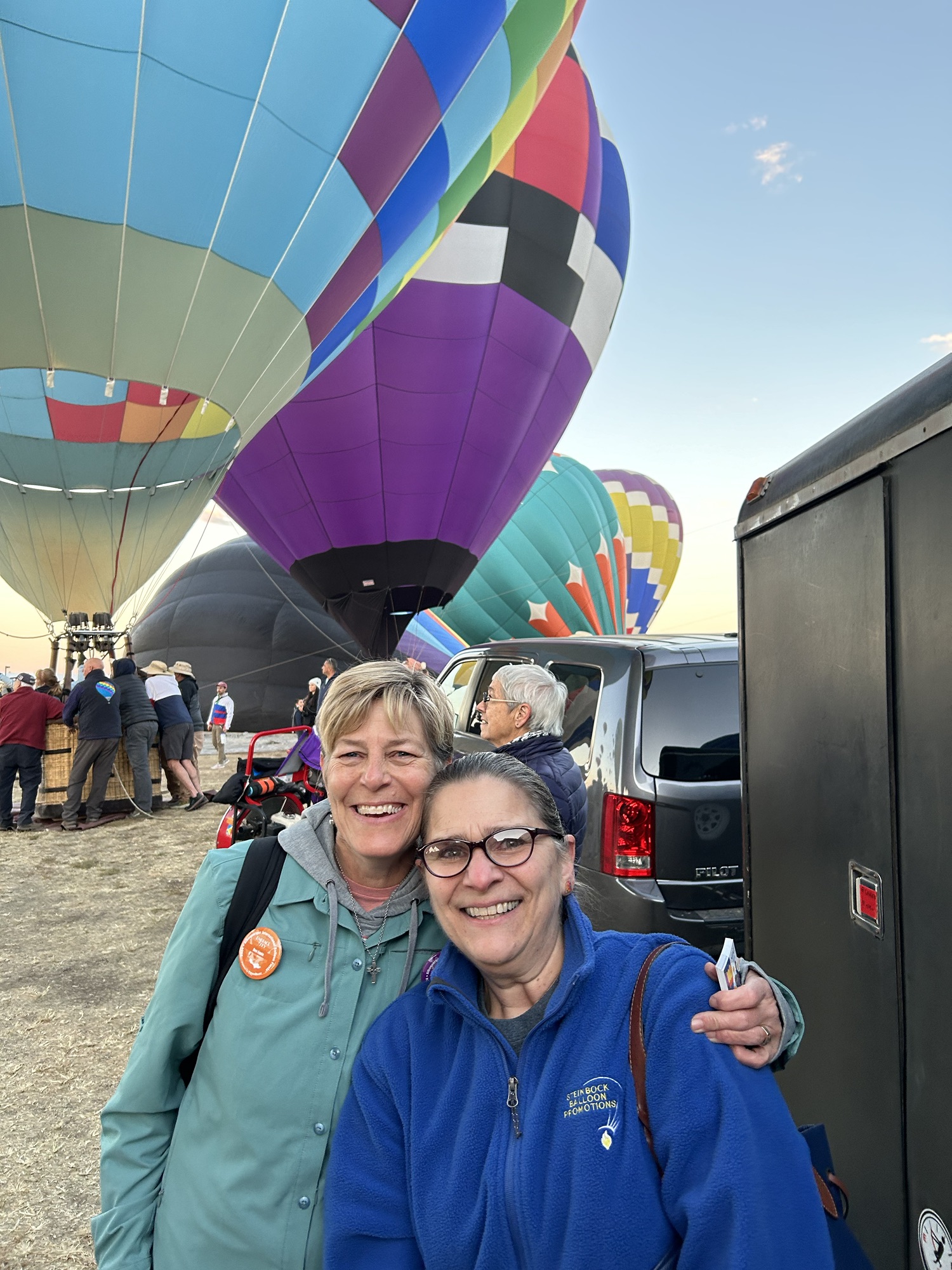
Ten days ago, Connie and I were winding down our fabulous road trip to the American southwest, when Instagram noted that the Balloon Fiesta was happening in Albuquerque, only three hours and 15 minutes away. We texted some old friends Karen and Ed who love the Fiesta and they just happened to be there working as a ground crew for a corporate hot air balloon. We decided to meet up. After buying tickets we texted them a question about parking. They responded “Hold on. We are working on something”. What they worked up was VIP parking passes, a golf cart shuttle, food, beverages and restrooms inside a corporate sponsored VIP tent, the experience of serving on a hot air balloon ground crew, and then they guided us around the 80 acre launch field explaining the finer points of ballooning as 550 hot air balloons filled the morning sky. We asked “where to park”, and they gave us a VIP experience we will not soon forget. Who would not love neighbors like Karen and Ed?
Jesus challenges us to not just love good neighbors, but show compassion and offer care for bad neighbors as well. “If you love those who love you, what credit is that to you? Everyone loves people who love them. If you do good to those who do good to you, what credit is that to you? For even sinners do the same. If you lend to those from whom you expect to receive payment, what credit is that to you? Instead, love your enemies, do good, and lend, expecting nothing in return. Your reward will be great, and you will be children of the Most High, for God is kind to the ungrateful and the wicked. Be merciful, just as your Heavenly Father is merciful.” (Luke 6) Do this and live. Love people and become the children of God. Practice mercy and become merciful.
“Who is my neighbor?”, our lawyer asks, trying to find that Biblical loophole to help us escape loving bad neighbors? You likely know the story Jesus told us to define “neighbor”.
Who is my neighbor? Jesus replied, “A person was going down from Jerusalem to Jericho, and fell into the hands of robbers, who stripped them, beat them, and left them half dead beside the road. By chance a priest was going down that road. The priest saw the beaten and bloodied man and stepped to the other side of the road. Levite also looked away from the suffering. But by chance a Samaritan came traveling down the road. Jesus does not need to mention the racial, religious, and cultural history of tension and trauma between his Jewish listeners and the deeply-othered Samaritans. Unlike the congregational leaders, this Samaritan did not cross to the other side. No after seeing the need, they drew near to the suffering and were moved with compassion. Drawing near to the half-dead brother, they bandaged their wounds and laid them gently on their saddle and carried them to an inn. The Samaritan took care of the injured person all night. The next day the Samaritan gave a few hundred dollars to the innkeeper promising, ‘Take care of this soul and when I return, I will repay you for whatever else you need to spend on their care.” I might have asked the innkeeper or the local congregation to help out with the bill a little bit, I mean I did not rob the guy, but the Samaritan took on the wounded person’s burden as if it was their own…. That is radical love.
Bind up the wounds of half-dead enemies. Pay for the healthcare of those who might under other circumstances despise or exclude you. Show mercy. Practice compassion. Do this and live. Do this and maybe you will step into that holy joy that flows from the Holy Spirit.
Preacher, lay leader, Samaritan: Which of these three, do you think, was a neighbor to the man who fell into the hands of the robbers?” The lawyer answered, “The one who showed him mercy.” Jesus said to him, “Go and do likewise.” Go and show mercy. Be the one who shows mercy. Go and order your life around loving God and people. Go and see everyone with compassion. Go, take the narrower and harder path of loving people, and you will become the person God created you to be: a child of God, a person of Love. Amen.
 pastorpaulpurdue