
When one of our good friends was expecting her second child, her three year old had a lot of questions. Three year-olds remind us that questions open the door to knowledge. Do we use the word “expecting” to describe pregnancy because we do not know what the future holds? Will the baby sleep, will we sleep, who will they become? Little Allison seemed especially intrigued by her future sibling’s name. Allison liked to lay on her mommy’s belly and talk to her unnamed coming sibling. Lacking a name for her sibling, Allison had made up a name: “Nex-a-who”. “Nex-a-who” seemed like a brilliant choice as it held three mysteries: Next, Who and Thing-A-ma-bob: “Nex-A-Who”. Our Friends named the baby “Chris”.
Mary was expecting. An angel told her to name her baby: “Jesus”. Jesus in Hebrew means “God saves” (Matthew 1:21) An unwed mother in the first century faced physical, economic, and cultural danger. Leviticus’s purity laws prescribed violence for promiscuity outside the bounds of traditional marriage. Mary’s story is hardly traditional.
What did Mary expect? How did she process the angel’s words: “Greetings, favored one! The Lord is with you. Do not be afraid. You will conceive, bear a son, and name him Jesus. Jesus will be called the Son of God. The Lord God will give your baby King David’s throne and Jesus’ kingdom will never end. God’s power will be with you and the child will be holy. Nothing is impossible with God.” Mary was perplexed and asked:“How can this be?” but Mary answered “Yes, here I am ready to serve, Lord, let it be.”
I keep imagining Mary gently holding her belly as she ponders the future. Christian theology teaches us that God exists in perfect unity inside of a Trinity: Creator, Christ and Holy Spirit. At Christmas we celebrate the incarnation, God’s deepest communion with humanity. John declares “the Word became flesh and dwelt among us” (John 1). Our baptism liturgy declares Jesus was “nurtured in the water of Mary’s womb”. So imagine Mary holding in her belly the God of the Universe. Mary nurtures in her body: Christ, God, the Incarnate Word, Emmanuel, God with us. Perhaps we grasp such mysteries better through signs, symbols and art, than through definitions, science, and theology. The angels invite us to look for symbols: “And this shall be a sign unto you: You will find the Babe wrapped in swaddling clothes, lying in a manger.”? (Luke 2) What signs and symbols are guiding us to Christ this Christmas?
Ponder with me the sign of Mary holding in her belly the God of the Universe?
What did Mary expect for that baby gently kicking inside her belly? What would Jesus bring into the world? What will Jesus bring into your world?
A few years ago, Rev. Kate Fields preached on Mary’s Magnificat and shared how she imagined Mary teaching her song to Jesus as he grew up. Mary’s prophetic song shaped who Jesus grew up to become and her song became part of our Scripture.
She begins, “My soul magnifies the Lord, and my spirit rejoices in God my Savior,
for God has looked with favor on the lowly state of his servant.”
Threatened by an oppressive culture, Mary delights in God. She pauses and magnifies the Lord. She praises, considers, and glorifies God despite the trauma around her. I think Mary knew the daily practice of prayer, praise and meditation, so that amid grave uncertainty, Mary knew how to connect her spirit with God‘s Spirit. “In the depths of who I am I rejoice in God my savior.” She has peace amid the potential storm as she dwells in God’s presence.
“Surely from now on all generations will call me blessed, for the Mighty One has done great things for me! Holy is God’s name. God’s mercy is for those who worship God from generation to generation.”
Mary is right. Churches and people all over the world put up statues of Mary: Faithful One, God Bearer, Queen of the Heaven, Holy Mary, Mother of God. Five hundred years after our reformation, some Protestants are coming back around to understanding Mary, as much a prophet like Paul and an essential part of Christ’s Incarnation.
Mary sings on. “God has shown strength with his arm; scattering the proud in the imagination of their hearts. God has brought down the powerful from their thrones and lifted up the lowly; God has filled the hungry with good things and sent the rich away empty. God has come to the aid of his child Israel, in remembrance of God’s mercy, according to the promise God made to our ancestors,to Abraham and to his descendants forever.”
I went into the sanctuary this week and looked over our Chrismon tree. We have beautiful Chrismon ornaments reminding us that Jesus is the Alpha and Omega, our Savior, Son of God, Lamb of God, Prince of Peace, and True Vine. Lovely reminders, but I noticed our tree is missing something. We do not have any Chrismons telling us how Christ came to lift up the lowly, fill the hungry with good things, send away the rich empty handed, cast down oppressive rulers, break the delusions of the proud, welcome the immigrant or turn over unjust thrones. I grew up in a denomination that never talked about God’s call to Justice, equality and inalienable human rights. We talked about doing good for the needy, but we never got upstream of the problems to address systemic injustice. Without images on our trees, in our songs, or in our minds, I wonder if we will remember how Jesus came to bring justice? So I thought I might share some images of Christ who comes to bring justice.
In Luke 4 Jesus defines his mission preaching, “The Spirit of the Lord is upon me, because God has anointed me to bring good news to the poor, to proclaim release to the captives, recovery of sight to the blind, and to set free those who are oppressed…” His mamma would be proud!
In Luke 6 Jesus’ beatitudes offer a blunt rebuke of the economic order: “Blessed are you who are poor, for yours is the kingdom of God. Blessed are you who are hungry now, for you will be filled. Blessed are you who weep now,for you will laugh…. But woe to you who are rich, for you have received your consolation. Woe to you who are full now, for you will be hungry. Woe to you who are laughing now, for you will mourn. Woe to you when all people speak well of you, for that is how their ancestors treated the false prophets.”
In Luke 12 Jesus teaches: “Be on your guard against all kinds of greed, for one’s life does not consist in the abundance of possessions.” That is a message that might save your soul from emptiness, but how would we feel if we read it on a Christmas card?
In Luke 16, Jesus tells a parable of a rich person “who was dressed in purple linens and feasted on lavish meals every day. Outside the gated community lay a poor man named Lazarus. Lazarus was covered with sores and hungry. Lazarus longed for the food that the rich guy threw away. When the poor man died the angels carried him to be with Abraham and the saints. When the rich man died, he was buried. In Hades, the rich man lifted up his eyes and saw Abraham up in heaven and called out, ‘Father Abraham, have mercy on me! Send Lazarus down to bring me some water.’ (Even in Hell the rich man needed help understanding his privilege thinking that Lazarath should wait on him). But Abraham answered, ‘Oh Child, you’re stuck. Remember how you received so many good things during life? Now Lazarus is comforted and you are in agony.” Now this is just a story Jesus told, so let’s not get all literal and send every billionaire to hell, but Jesus’ story reminds us that Jesus comes to bring about justice, equity, and enough for everyone.
Finally, let’s remember how Jesus rode into Jerusalem. Mark 11 tells us Jesus “entered the temple and began to drive out those who were selling and those who were buying in the temple, and Jesus overturned the tables of the money changers and the seats of those who sold doves, and Jesus would not allow anyone to carry anything through the temple. (The Temple complex was about 35 acres. So imagine shutting down a space that big on the number one holiday shopping day of the year.) Jesus was teaching, “Is it not written, ‘My house shall be called a house of prayer for all the nations’? But you have made it a den of robbers.” Maybe we could make a Chrismon of Jesus cleansing the Temple: an upside down money changers table with little coins dangling down or a dove’s cage with bars cut open and the doves free to come and go?
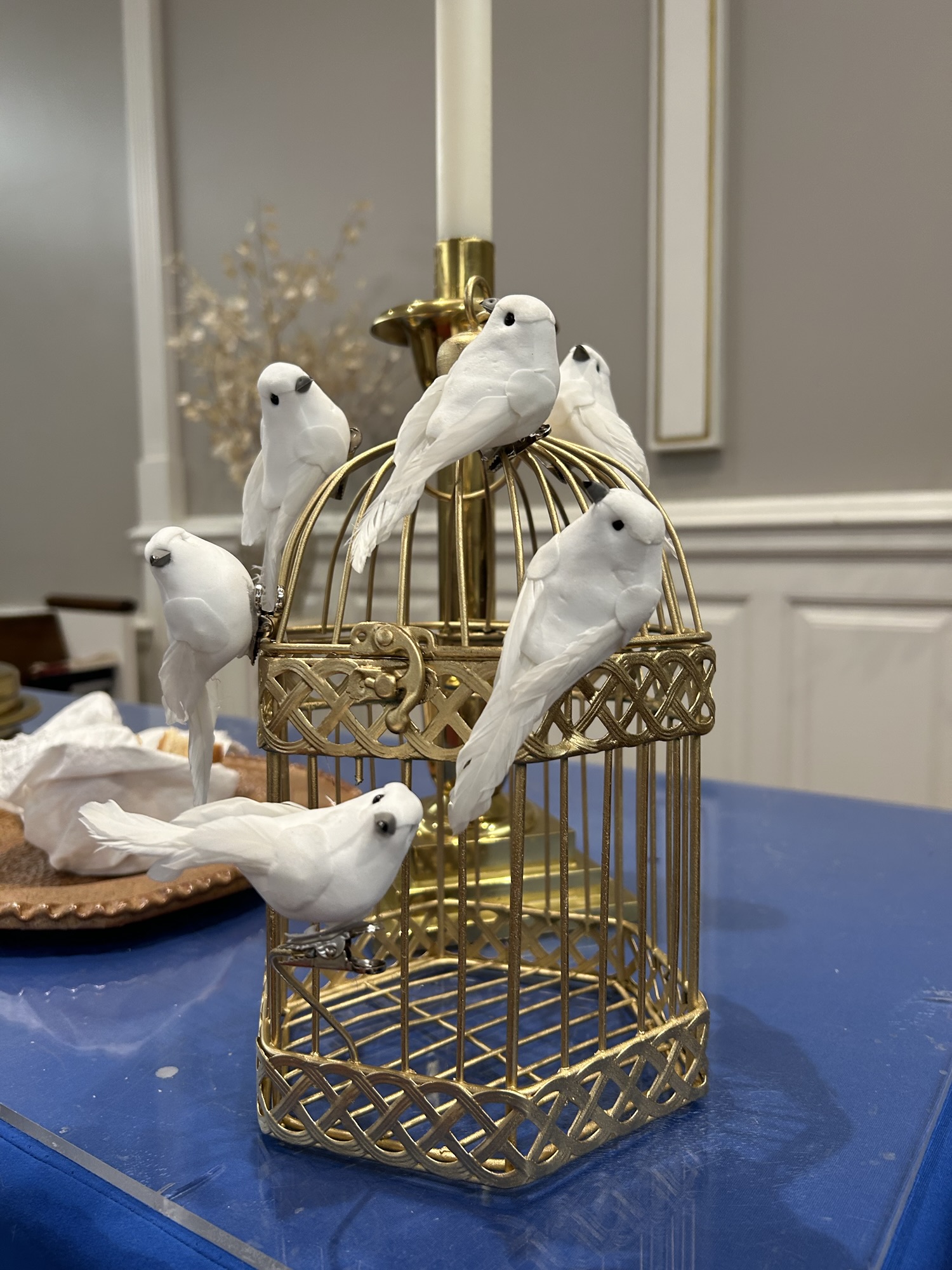
What do you expect Jesus to bring into your world this Christmas? God’s Presence and peace? Yes. Comfort and joy? Yes! Salvation and courage? Yes! Faith, Hope, and Love? Absolutely! But, will we remember how Jesus calls us to: reject the forces of evil, resist oppression, overturn unjust thrones, give good things to the poor, send away the rich empty handed, and demand justice for all people? (Luke 1:46-55) Maybe the manger itself, Jesus born in a barn and laid in a cow’s feedbox, itself is an image of God’s deepest identification with the poorest of people: the unhoused, the outcast, and the migrant? Oh may the peace of Christ fill us with wonder, joy and hope this Christmas and then finish its work by empowering us to build God’s kin-dom of welcome, justice and equity. Amen
 pastorpaulpurdue