
Luke opens the “Good News” of God’s coming Kingdom (Luke 8:1) with a little contrast: “During the rule of King Herod of Judea there was a priest named Zechariah”. There were tens of thousands of lay priests in Israel but one King. King Herod was an agent of the Roman Empire having been appointed by the Roman Senate for 40 years, originally sponsored by some buddies Octavious and Antony. (AT Robertson’s Word Pictures) Herod was a connected, powerful and an especially cruel king. The priest, Zechariah and his partner Elizabeth “were both righteous before God, blameless in their observance of all the Lord’s commandments and regulations” Luke adds “They had no children because Elizabeth was unable to become pregnant and they both were very old.”
We don’t know what Zechariah and Elizabeth’s home life was like. I imagine their relationship bore the spiritual fruit of keeping God’ commandments: love, joy, peace, patience, kindness, gentleness, faithfulness and self control. We know that when Mary learns she will have a child before marriage and outside the law, she runs to find sanctuary with Elizabeth and Zechariah. Zechariah and Elizabeth will raise John the Baptist, a powerful voice for justice and poor people. As a child John learned the stories of prophets like Moses, Ester, Rehab, and Elijah from his mother and father. John’s political movement led a second King Herold to imprison and murder him.
Do you ever want to jump straight into Christmas joy and sing with the angels “Glory to God: Good News of great joy for all people!”? That is not how Luke begins. Luke tells a story of an old priest and his partner living with the weight of our weary world and even “the reproach of their people”.
Zechariah was one of thousands of lay-like priests who served two week shifts plus 3 weeks during the annual pilgrimages. King Herod rebuilt the tiny post-exile Temple making it one of the wonders of the ancient world. Herod’s Palace shared courtyards with the Temple. King Herod even appointed the High Priest, usually to the highest bidder. Do you wonder what Zechariah and Elizabeth thought of such gross church hypocrisy? Do you think they were tempted to stop going to church and do faith alone? How does a weary world rejoice? Perhaps with faithful people who do not give up on doing what they can to serve God, church, and their neighbors!
There were so many part time volunteer priests, they cast lots to see who got to serve as liturgist. And the lot fell to Zechariah. With thousands of priests, It was a once in lifetime opportunity to put on the purple linen vestments, the ruby bedazzled ephod, and to have an old friend tie the anklet bells around your ankles. (Exodus 28) Luke tells “all the people who gathered to worship were praying outside.” I love Luke’s image of Zechariah surrounded by the presence and prayers of a community of love and forgiveness.
After washing his face and hands, Zechariah entered the inner sanctuary alone. He scooped red-hot coals from the fire, placing the coals on the altar and then pouring the sweet smelling spices, cinnamon, cedar, and frankincense over the flaming coals. As the incense burned the smoke ascended up to heaven. Did Zechariah remember God’s promise about the altar “I shall meet with you there before the altar.”? (Exodus 29-30)
The word angel means “messenger” from the Lord. In the midst of these liturgical movements an angel appeared to Zechariah standing to the right of the altar of incense. Zechariah was startled; overcome with fear. The angel said, “Don’t be afraid, Zechariah. Your prayers have been heard. Your wife Elizabeth will give birth to your son and you must name him John. John will be a joy and delight to you. John will be great in the Lord’s eyes and filled with the Holy Spirit even before birth. John will bring many people back to the Lord. John will go forth before the Lord, equipped with the spirit and power of Elijah, turning the hearts of parents back to their children, and the disobedient to righteous ways. John will prepare the people for the Lord.” I imagine that Zechariah’s prayers had moved past praying for a child. Indeed, Zechariah seems content without a child: “blameless” Luke said. I imagine Zechariah was praying and striving for the restoration of a church and community deeply corrupted by the Roman Empirical values. John’s dad surely hated that the high priesthood for sale and the Temple money changers exploited the poor. Let’s not miss the angel’s deeper promise: the restoration of community: God’s kin-dom filling the people’s heads and hearts. Oh that justice might roll down like the mighty waters… ( Amos 5)
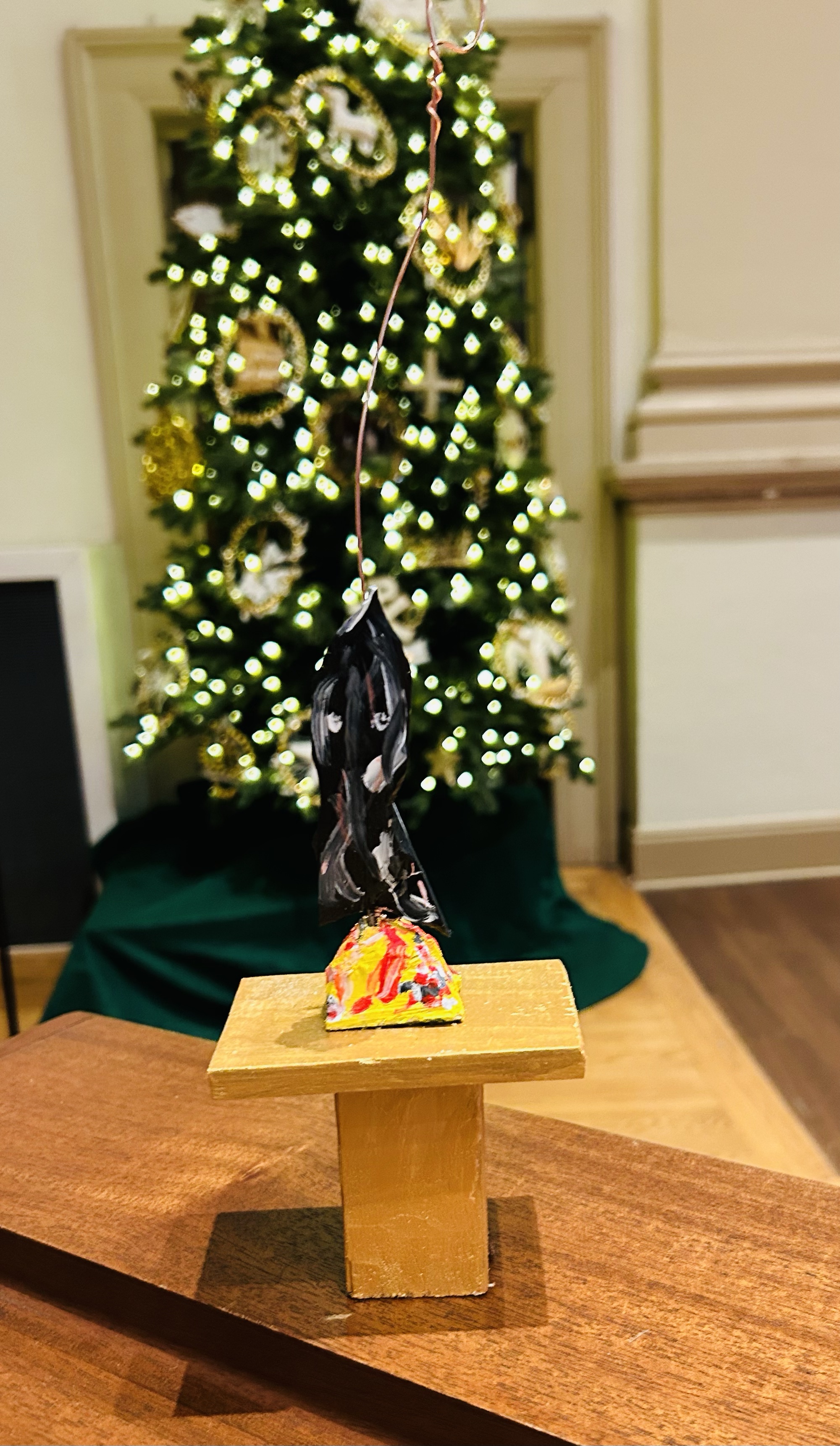
In the foyer to my right is a copy of a beautiful painting, “Annunciation to Zechariah by Lauren Wright Pittman. For me it shows Zecheriah holding the dream of a child. It is from Sanctified Art, who gave us this series theme. I invite you to view it, but more than that to ponder what dreams might God re-light in you?
Pondering the hope of children and then communities finding the way back to the Lord asks, for all of us: “How can I be sure of this?” How can I believe this? How can I be sure this is the right moment, right choice, right college, right career, right part, right time, right town, right one? How can I be sure enough to try again? Do we risk believing God’s Kin-dom might come and that we might do something to help bring it about?
I think the angel is a kind of a bully. Gabriel’s pride takes a ding because Zecheriah is not starstruck into belief by Gabrial’s golden wings and halo. The bragging angel starts name dropping the “Great I AM”: “I am Gabriel. I stand in God’s presence. I was sent to speak to you and to bring this good news to you.” (Look at me! You should be impressed!) so know that what I have spoken will come true at the proper time. But because you didn’t believe it, you will remain silent, unable to speak until the day when these things happen.” Yuck. I hope that when Gabrial flew back to heaven, God said, “Gabriel, let’s work on your people skills! Check out how Jesus will move with compassion!.” Maybe the silence came as a hidden blessing, maybe Zechariah needed inner quiet to believe. No doubt Zechariah and Elizabeth adjusted to one more difficulty and kept moving. Sometimes blameless living involves taking the next faithful steps in silent resilience.
After burning the incense and lifting the people’s prayers, Zechariah’s final duty was to speak the benediction over the congregation who waited outside: “The Lord bless you and keep you; the Lord make his face to shine upon you and be gracious to you; the Lord lift up his countenance upon you and give you peace. (Numbers 6:24-26) As a young priest, I would have dreamed of that moment all my life, dressed in the shimmering vestments, ruby breastplate, ephod, robe, and tunic standing in the National Sanctuary proclaiming the beloved blessing. But Zechariah could not speak, he could not fulfill his priestly duty. Zechariah has seen the Lord, caught the vision, but he can not speak or finish his task: and yet, amid our weariness and disappointments holy moments still bring reasons to rejoice.
The people were waiting and wondering why Zechariah was in the sanctuary for such a long time. The congregation who upheld Zechariah with their prayers and presence knew God had done something special. He could not deliver his lines, but the crowd did not whisper, “what’s wrong with Zechariah?” or walk from church disappointed at the fumbled liturgy. No, they saw the holy in Zechariah’s silent inability. How often do we judge ourselves more harshly than those who have vowed to surround us with a community of love and forgiveness?
Zechariah sees an angel, hears God’s promise of a child, hears God’s promise of restored community, is struck mute, and finally, when his two week shift is over Zechariah goes home. Zechariah, one of thousands priests, sticks out the remainder of his appointed service. He does not rush home to write a note to Elizabeth. Often we want to burst straight into that Holy Night, to sing with the angels: Glory to God in Highest Heaven to sing the good news for all people… but the good news begins with the silent, questioning, humble, perhaps misunderstood, resilient faithfulness of people like Zechariah and Elizabeth. How does a weary world rejoice? Perhaps by just doing the next thing we can do. Amen.
 pastorpaulpurdue