
Our lectionary reading comes from the Book of First Kings. Kings, like Samuel and Chronicles, reads like history but lifts up some events while completely ignoring others. “Kings” is concerned with one thing: “Did the king do evil in the eyes of the Lord?” ( 1 Kings 16) After that moral assessment Kings reflects very little about building projects or an increased GDP, stating “for the other events of (a King’s) reign, what they did and the things they achieved, are they not written in the book of the Annals of the Kings of Israel?” ( 1 Kings 16)
In chapter 16, the writer judges King Ahab, who ruled over Northern Israel for 22 years, saying “King Ahab acted as if it was a light thing to walk in the sins of King Jeroboam (who appointed priests, erected sacred poles and altars to the Canaanite goddess Asherah, and enslaved Hebrews), but King Ahab married Princess Jezebel of the Sidonians, and began to worship and serve the storm god Baal, even building an altar and temple for Baal in Samaria.”
Jesus reminds us that prophets challenge evil, injustice and oppression. We often forget one of the Beatitudes: “Blessed are you when people revile you and persecute you and utter all kinds of evil against you falsely on my account. rejoice and be glad, for your reward is great in heaven, for in the same way they persecuted the prophets who were before you.” (Matthew 5) As Jesus rides into his nation’s capital on Palm Sunday, Jesus weeps over the nation, “Jerusalem, Jerusalem, the city that kills the prophets and stones those who are sent to it! If you only knew the things that make for peace… How often have I desired to gather your children together as a hen gathers her brood under her wings, and you were not willing!” What a beautiful image of God as a mother lovingly seeking to coax her children into peace and safety. While carrying the cross Jesus sees women weeping with him and says “daughters of Jerusalem, do not weep for me, but weep for yourselves and for your children.” (Luke 23) Jesus knows that princes, principalities, and systems often ignore the things that make for peace, justice, and human rights. Jesus weeps over these systems and those who fear them.
Elijah shows up out of the blue with no back story. Elijah stands before King Ahab and declares with an oath, “As the Lord the God of Israel lives, before whom I stand (which is kind of a shot at King Ahab before whom Elijah also stands), there shall be neither dew nor rain these years, except by my word.” This is a challenge to Ahab’s storm god. A drought is terrible news for any ruler. Rain grows the crops that feed the people and sustains the olive oil, citrus, wine, and almond production that Israel counts on for trade dollars. We do not know what King Ahab said back to Elijah, but “The word of the Lord came to Elijah, saying, “Go from here and turn eastward, and hide yourself by the Wadi Cherith, east of the Jordan. Drink from the wadi, and know I have commanded the ravens to feed you there.”
If you keep reading through the book of Kings, you may wish Elijah abided by the Sermon on the Mount. He does not. You will read tales of Elijah praying down fire and lightning from heaven and sending rain at Yahew’s command. Elijah reads like a comic book superhero more than a normal person like Abraham, Isaiah, or Ester. In our text this prophetic superhero flees and hides in the wilderness. In Chapter 19, after winning a sweeping victory over the prophets of Baal at Mount Carmel, Elijah again runs for his life, sleeping under trees in the wilderness and praying “Lord, I am the only one left and they want to take my life too.” It is a fact, our president-elect has engaged in racist and misogynistic language, promised retribution on his political enemies, and called for mass deportations. If you are feeling like running away and hiding, you might be in good company- biblical company.
Hear the Good News: God never gives up on any of us. God is always working to make all things new. (Isaiah 43) God provides for Elijah. The way God provides for Elijah, makes for a good story. I read in the NYT how a murder of crows can hold grudges up to 17 years and how the French have trained crows to pick up cigarette butts in a city park. Scholars explain this mystery meal in different ways, but I just like the wonder of God’s provision “The ravens brought Elijah bread and meat in the morning, and bread and meat in the evening; and he drank from the wadi.” How hungry would you need to take an open bag of chips from a Raven?
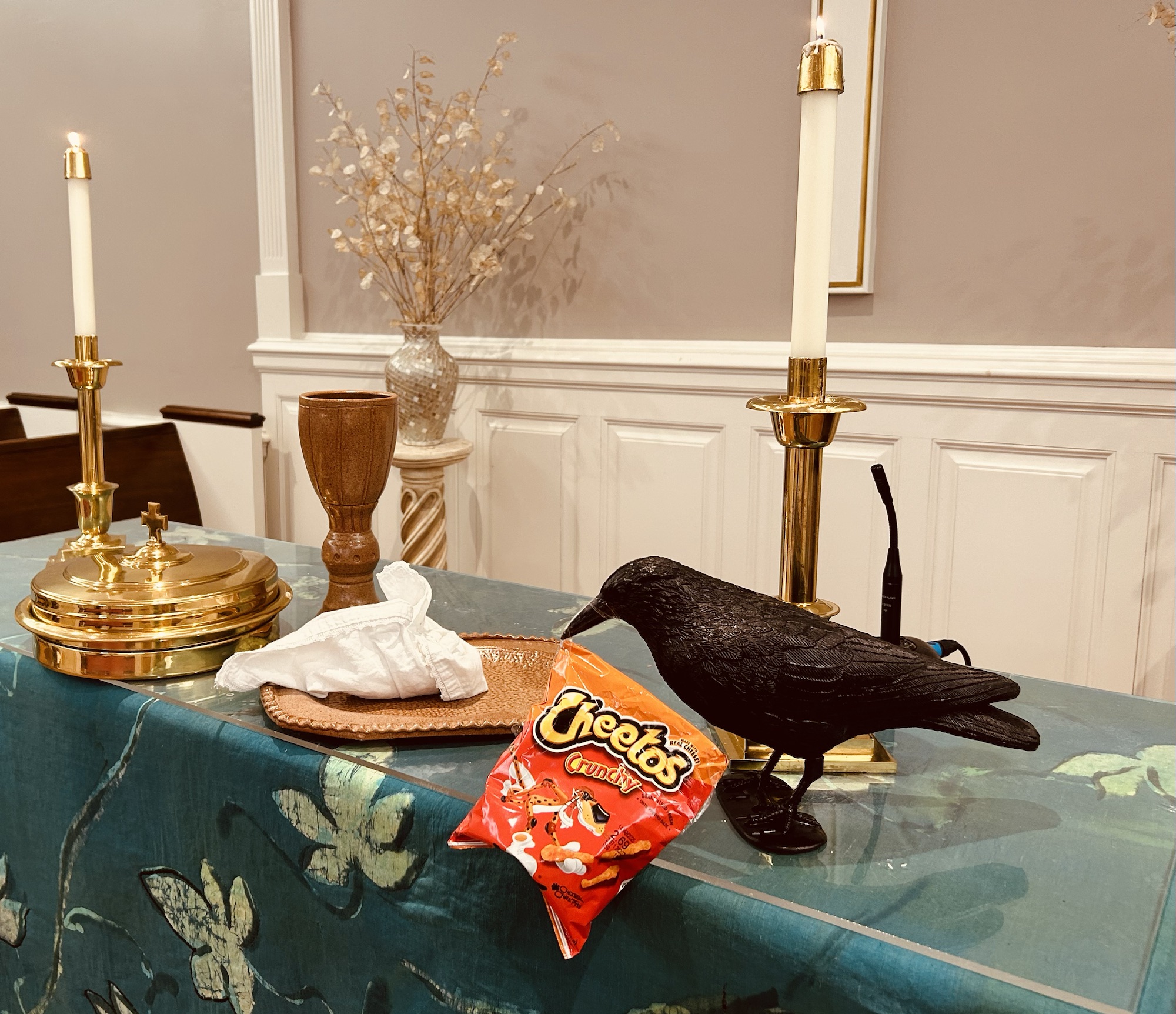
Why a raven? Why did God not send a nice big horned sheep with a beautiful grape leaf gyro tucked between its curly horns? Why bread from a raven? Leitivicus 11 declares: “These you shall regard as detestable among the birds… they are an abomination: eagle, vulture, osprey and every kind of raven of any kind…. everyone who touches one of them shall be unclean.” These “detestable” birds save Elijah. These unclean birds bring sandwiches and preach inclusion. How is it that 2,000 years later, churches ignore Peter’s sermon in Acts 11, “God has shown me that I should not call anyone profane or unclean!” Could it be that God’s salvation comes in unexpected, unorthodox and unexpected ways?
“But after a while the wadi dried up, because there was no rain in the land.” Feeling his thirst the word of the Lord again came to Elijah, “Go now to Zarephath which belongs to Sidon. “I have commanded a widow there to feed you.” I got to believe Elijah rejoiced to no longer be fed by ravens.
Did you catch that town’s name: “Sidon”? Queen Jezebel, who the writer counts as wicked, was from Sidon. God is sending Elijah to Queen Jezebel’s hometown. Zarephath in Sidon was a safe harbor for Mediterranean shipping; a larger port city with strong industry. Zarephath produced and exported wine, grain, olive oil, purple dye, metallurgy, and pottery to cities all over the mediterranean coast. Why does God send Elijah to a Baal worshiping city? I will give Elijah some props, because unlike Jonah, Elijah goes willingly to hide in plain sight among the Cannanites.
As Elijah approaches the city walls and gate, he sees a widow gathering sticks for a cooking fire. Having no money for fuel or firewood, poor people still collect fallen sticks for little cooking fires. Elijah calls to the widow, “Bring me a little water in a vessel, so that I may drink.” And as she silently goes for water, Elijah perhaps pleads, “Bring me a morsel of bread in your hand.” The widow straightens up and with an oath says, “As the Lord your God lives, I have nothing baked, only a handful of meal in a jar, and a little oil in a jug; I am now gathering a couple of sticks, so that I may go home and prepare it for myself and my son, that we may eat it, and die.” She repeats Elijah’s oath to King Ahab with a twist, pointing out their religious differences and their shared need for food.
I have never worried about where my next meal might come from. Like the rich folks in our gospel lesson, I have known abundance. And yet, it is so easy to fall into a scarcity mindset, to worry that we do not have enough or believe that we can not afford generosity. Worshiping our possessions we think if I give away these two coins, how will I get by?
But this widow, having almost nothing, practices generosity. She hears the cry of the needy! She extends her table. Not only does she feed Elijah a meal, she welcomes Elijah into her home. Before feeding her family, she starts a fire from the sticks, takes a handful of corn meal, pours the oil from her jar, and makes some fried bread. Elijah was hungry and she fed him. Elijah came as a stranger and she welcomed him in. Elijah was an immigrant and she provided him a community. Elijah was a fugitive and she gave him refuge. Elijah worshiped a different god and she broke bread with him. Elijah had been unhoused, she gave him a home. She did not have enough, but she extended her table and gave. There is a deep miracle in radical openness and generosity- somehow we have enough. Jesus promises, give and you will receive. (Luke 6) Somehow generosity saves us. Somehow, compassion saves us. Somehow, openness saves us. It is a holy mystery, but somehow giving gives us enough.
Our world needs your generosity right now. “You are the light of the world. A city built on a hill cannot be hidden. People do not light a lamp and put it under the bushel basket; rather, they put it on the lampstand, and it gives light to all in the house. In the same way, let your light shine before others, so that they may see your good works and give glory to our God in heaven.” (Matt 5) We need each other and the world needs us. We need to stand together: straight and queer, men and women, trans and traditional, native born and immigrants. Our neighbors need to know that they can find an accepting sanctuary among us.
I wonder as Elijah tasted a meal set before him by human hands, if Elijah told the widow and her son about the crows? I wonder after super, as she tucked her boy in bed, if they laughed together about the strange preacher living in their attic?
We are not told exactly the science of how the cooking oil never ran out. We only know they always had enough. Through generosity, she who had seemingly nothing, found she had enough. And the prophet who preached against Baal found refuge as an immigrant among people who worshiped that different God. Sadly, if you read on, Elijah does not seem to hold onto these lessons, but we can.
You may feel that you have nothing left to give- Hear the Good News: we have enough. You may feel alone, together we make a sanctuary. The best slogan we Methodists ever made was “open hearts, open minds, open doors”. May we be open. May we be generous for there is a miracle of generosity that somehow makes enough for us all. May we be the widow, who opens her home, hands and resources to make room, trusting God will bring us enough. Oh, how we need each other right now. How, we need everybody. Oh how, we need to be God’s sanctuary for all people, for who knows who will save us. Let us risk opening our wallets, hearts, and hands and give with an openness and generosity for in doing so we may come to know enough. Amen
 pastorpaulpurdue
BravoSent from my iPhone